


Arianna Huffington
The one that shows the way from the Labyrinth
Her name is on Time Magazine's list of the world’s 100 most influential people and the Forbes Most Powerful Women list. From Greece to the US, she leads an interesting life. Author, journalist, political commentator, businesswoman even a candidate for Governor of California, she has always been an independent, hard-working and very successful woman. Arianna Huffington's personal wake-up call came in the form of a broken cheekbone and a nasty gash over her eye - the result of a fall brought on by exhaustion and lack of sleep. That’s when she started wondering what success really is and wrote Thrive: The Third Metric to Redefining Success and Creating a Life of Well-Being, Wisdom, and Wonder.
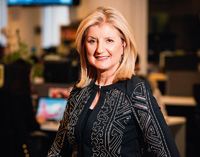
Arianna was born in Athens, Greece in 1950 as Ariadni-Anna Stasinopoulou. Daughter of a journalist, she left home early in pursuit of her education. She moved to the United Kingdom at the age of 16, and studied economics at Girton College, Cambridge, where she was the first foreign, and third female President of the Cambridge Union.
The 1970s were her years of developing as a writer. She started writing books with editorial help from Bernard Levin, a slightly older English journalist and author with whom Arianna had a romantic relationship until she was 30.In 1973, Arianna (as Stassinopoulos) wrote a book titled The Female Woman, attacking the Women's Liberation movement in general. In the book she wrote, "Women’s Lib claims that the achievement of total liberation would transform the lives of all women for the better; the truth is that it would transform only the lives of women with strong lesbian tendencies."
At the age of 30 she had ended her long relationship with Levin. She wanted a family and children, he didn’t. After his death in 2004 she said: "He wasn't just the big love of my life, he was a mentor as a writer and a role model as a thinker."A new chapter of her life awaited in New York, where she moved in 1980.
Huffington continued writing, and in 1981 she wrote a biography of Maria Callas, Maria Callas – The Woman Behind the Legend, and in 1989, a biography of Pablo Picasso, Picasso: Creator and Destroyer.
In 1985, Arianna met her future husband, Michael Huffington. They married and she became his greatest support when he ran for congress in 1992.They have two daughters, Isabella and Christina. The couple divorced in 1997.
She wasn’t the usual politician’s wife that shows silent support for her spouse. Huffington rose to national prominence during the unsuccessful Senate bid in 1994 by her then husband, Republican Michael Huffington. She became known as a reliable supporter of conservative causes. As late as 1998, Huffington still aligned herself with the right. During that year she did a weekly radio show in Los Angeles called "Left, Right & Center" that matched her, the right-winger, against a self-described centrist policy wonk, Matt Miller, and a veteran leftist journalist, Robert Scheer. In an April 1998 profile in The New Yorker, Huffington was described: "Most recently, she has cast herself as a kind of Republican Spice Girl - an endearingly ditzy right-wing gal-about-town who is a guilty pleasure for people who know better." At that time, Huffington described herself by side-stepping the traditional party divide, saying "the right/left divisions are so outdated now. For me, the primary division is between people who are aware of what I call 'the two nations' (rich and poor), and those who are not."
Huffington opposed NATO intervention against Serbia in 1999.
Prior to The Huffington Post, Huffington hosted a website called Ariannaonline.com. Her first foray into the Internet was a website called Resignation.com, which called for the resignation of President Bill Clinton and was a rallying place for conservatives opposing Clinton. She wrote about Clinton resigning, "Only some act of sacrifice can begin to restore the image of the President that we are left with – a man of staggering narcissism and self-indulgence, whom nobody dared gainsay, investing his energies first in gratifying his sexual greeds and then in using his staff, his friends and the Secret Service to cover up the truth."
During the Clinton Saga, Arianna transformed from a conservative to a liberal. Although she would not call herself that. As she explained in an interview with CNN in 2000: “I don't consider myself as being transformed from a conservative to a liberal. I consider myself being transformed from a conservative to a populist. Through the last six years of doing a syndicated column twice a week and through writing a book, "How to Overthrow the Government," I had to confront the data about poverty and about the failed drug war – about the corruption of our politics. Then, as a result, I became radicalized.
The reason why I would not describe myself as a liberal is because I don't consider poverty and issues of those left out of prosperity to be issues that belong to the left, but issues that are central to our democracy.”
In 2000, she instigated 'Shadow Conventions', political conventions whose purpose is as she explained to CNN at the time “to amplify the voices of those who will not be in the other conventions – are not on the contributor lists, do not buy access and whose issues are not on the table as a result”. Those issues that they were focusing on at the Shadow Convention were: “the corruption of money in politics, poverty in the middle of our prosperity and the failed drug war. In the case of the failed drug war, neither body has anything to say except "let's get tougher on it." And the first two issues are paid lip service to, but that is all.” The 'Shadow Conventions' appeared at the Republican National Convention in Philadelphia and the Democratic National Convention in Los Angeles at Patriotic Hall.
Huffington is the co-host of the weekly, nationally syndicated, public radio program Both Sides Now, along with Mary Matalin, former top aide to the Bush/Cheney White House. Every week on Both Sides Now, Huffington and Matalin discuss the nation's relevant political issues, offering both sides of every issue to the listeners.
Huffington was an independent candidate in the recall election of California governor Gray Davis in the 2003 recall election. She described her candidacy against frontrunner Arnold Schwarzenegger as "the hybrid versus the Hummer," making reference to her ownership of a hybrid vehicle, the Toyota Prius, and Schwarzenegger's Hummer. The two would proceed to have a high-profile clash during the election's debate, during which both candidates were rebuked for making personal attacks.
She dropped out of the race on September 30, 2003 and endorsed Governor Gray Davis' campaign to vote against the recall. Others attributed her exit to her inability to garner support for her candidacy, noting that polls showed that only about 2 percent of likely California voters planned to vote for her at the time of her withdrawal. Though she failed to stop the recall, Huffington's name remained on the ballot and she placed 5th, capturing 47,505 votes or 0.55% of the vote.
Huffington Post
The Huffington Post is an American online news aggregator and blog founded by Arianna Huffington, Kenneth Lerer, Andrew Breitbart, and Jonah Peretti, featuring columnists. The site offers news, blogs, and original content and covers politics, business, entertainment, the environment, technology, popular media, lifestyle, culture, comedy, healthy living, women's interests, and local news.
The Huffington Post was launched on May 10, 2005, as a liberal/left commentary outlet and alternative to other news aggregators. On February 7, 2011, AOL acquired the mass market. The Huffington Post was sold for US$ 315 million, making Arianna Huffington editor-in-chief of The Huffington Post Media Group. In 2012, The Huffington Post became the first commercially run United States digital media enterprise to win a Pulitzer Prize.
In July 2012, The Huffington Post was ranked #1 on the 15 Most Popular Political Sites list by eBizMBA Rank, which bases its list on each site's Alexa Global Traffic Rank and U.S. Traffic Rank from both Compete and Quantcast.
The Huff Post was launched in an era when print media giants were struggling to convert to digital form and at the same time maintain both their readership and advertisers. It seemed that Arianna knew what she was doing, again. Today the Huffington Post is a global network that consists of local versions (HuffPost Chicago, HuffPost New York, HuffPost Los Angeles…) and international editions which cover the UK, France, Japan, Germany and Hispanic and Arabic speaking countries.
What remained constant both for Huffington and The Huffington Post is innovation. Already mentioned, the 'Shadow Conventions' continued and the last ones happened in 2012, although that time they took a virtual presence. In 2012, the Huffington Post launched online "Shadow Conventions" to call attention to issues the site believed wouldn't be an official priority during the Democratic and Republican National Conventions that took place at the time.
For the Shadow Conventions, many sections of the Huffington Post website were taken over by content related to one of three issues: the war on drugs, the influence of money in politics, and poverty. The same issues which were the topics in 2000. Arianna found that both parties were still largely ignoring these issues, as a result of which each of these problems has gotten worse.
Each issue got a full day of coverage during each convention. Reporters covered the issues from their established angles — Hollywood reporters, for example, looked at how the war on drugs had been portrayed in films and on television. Roy Sekoff, President and Co-Creator of HuffPost Live, and Founding Editor of the Huffington Post commented at the time: "You'll literally go to the Huffington Post and have 20 different verticals with drug war splashes at the same time. It's very powerful. I don't think there are any other media organizations that can do that with the same breadth."
At the center of the Shadow Conventions was reader engagement — especially via the Huffington Post's recently-launched HuffPost Live interactive online video platform. Visitors were encouraged to read Huffington Post content on the issues, then engage in thoughtful discussions with Huffington Post reporters and experts on HuffPost Live throughout the conventions.
Thrive
In 2013 as the cofounder, the chair, president, and editor-in-chief of the Huffington Post Media Group-- one of the fastest growing media companies in the world, a nationally syndicated columnist, and author of fourteen books, celebrated as one of the world's most influential women, and gracing the covers of magazines, Arianna was, by any traditional measure, extraordinarily successful. Yet as she found herself going from brain MRI to CAT scan to echocardiogram, to find out if there was any underlying medical problem beyond exhaustion, after collapsing and injuring herself, she wondered whether this was really what success feels like?
Huffington wrote and published Thrive: The Third Metric to Redefining Success and Creating a Life of Well-Being, Wisdom, and Wonder in 2014, after her own revelation about life’s purpose and priorities.
As more and more people are coming to realize, there is far more to living a truly successful life than just earning a bigger salary and capturing a corner office. Our relentless pursuit of the two traditional metrics of success -- money and power -- has led to an epidemic of burnout and stress-related illnesses, and an erosion in the quality of our relationships, family life, and, ironically, our careers.
In being connected to the world 24/7, we're losing our connection to what truly matters.
Our current definition of success is, as Thrive shows, literally killing us. In a commencement address Arianna gave at Smith College in the spring of 2013, she likened our drive for money and power to two legs of a three-legged stool. They may hold us up temporarily, but sooner or later we're going to topple over. We need a third leg – a third metric for defining success – to truly thrive. That third metric, she writes in Thrive, includes our well-being, our ability to draw on our intuition and inner wisdom, our sense of wonder, and our capacity for compassion and giving. As Arianna points out, our eulogies celebrate our lives very differently from the way society defines success. They don't commemorate our long hours in the office, our promotions, or our sterling PowerPoint presentations as we relentlessly raced to climb up the career ladder. They are not about our resumes – they are about cherished memories, shared adventures, small kindnesses and acts of generosity, lifelong passions, and the things that made us laugh. And all this is coming from a woman used to working 18 hours a day, seven days a week, focusing on money and power.
Pairing bits of personal experience with the latest research, Huffington argues persuasively for a new paradigm of work and society. What she says is not new, but as a society we have a very short memory and we should be reminded often what the priorities are.
Arianna Huffington, daringly, advocates for the following: - Quality versus Quantity - know how much time you're willing to spend on something and what you meaningfully want to do in that time. - Reconnecting the stressed and overworked self - create some rules to remain grounded and wise. More sleep - less social media - knowing when to put down the technological influence that you have created over your life. - For corporations to put wellness initiatives place - seek out companies you know are aware and practical about the well-being of their employees. - Creating a mindfulness of how we interact with one another and the impact we have on another on an internal and human connection.
The beauty of the book is the interconnectedness of its content. The Third Metric comprises four pillars: well-being, wisdom, wonder, and giving. Far from simplistic, it's a well-rounded and gracious context for living life. This book is meant to challenge our perspectives of success beyond money and power. It's meant to open our eyes to the quality of our lives. It's not just about what happens to us and the path that we take in life. More so, it's about the quality of that path from an individual perspective to a larger point of view of community, corporations, and global changes.
We think, mistakenly, that success is the result of the amount of time we put in at work, instead of the quality of time we put in.
I do not try to dance better than anyone else. I only try to dance better than myself.
In these times we seem to wear busyness and stress as a badge of honour.


