


Interview
Barack Obama
Exclusive Interview with George Stephanopoulos
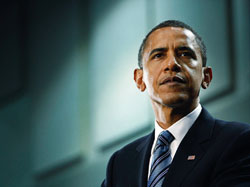
Barack Obama
The President of United States
Barack Obama is the 44th and current president of the United States, and the first African American to serve as U.S. president. First elected to the presidency in 2008, he won a second term in 2012.
Born on August 4, 1961, in Honolulu, Hawaii, Barack Obama was a civil-rights lawyer and teacher before pursuing a political career. He was elected to the Illinois State Senate in 1996, serving from 1997 to 2004. He was elected to the U.S. presidency in 2008, and won re-election in 2012 against Republican challengerMitt Romney.
President Obama continues to enact policy changes in response to the issues of health care and economic crisis.
By ABC news
“I guarantee you we will move this country forward. We will finish what we started. And we'll remind the world just why it is the United States of America is the greatest nation on Earth.” – Barack Obama
Mr. President, thank you for doing this.
It’s great to be here.
So, you’ve done all meetings on Capitol Hill, but I’m trying to figure out where this all goes. Because the– the Republican leader is still saying no revenues in any kind of a deal. I assume your bottom line is that any deal has to include revenues.
Right.
So, is your strategy to break them or to go around them? What is it?
I don’t think it’s to break or go around them. I think it is to identify– members, particularly in the Senate, but I think also in the House, who are just tired of havin’ the same argument over and over again. And– what I call the common-sense caucus, which says– we can do sensible deficit reduction with a combination of entitlement reform, some judicious spending cuts, closing some tax loopholes that nobody really defends on their own.
I mean, you don’t hear people say, “Man, that’s a great tax loophole– that we should keep.”
And if we do all those things, then instead of arbitrary cuts that hurt our economy, we can actually put in place– a growth strategy that creates jobs and protects the middle class and helps them thrive and grow. And that’s what I’ve been talking about for the last two years.
But that common-sense caucus on the Republican side, Lindsey Graham, Kelly Ayotte, other Senate Republicans say they’re gonna need to see a lot more entitlement reform from you before they can sign onto any new revenues, like putting– raising the Medicare eligibility age back on the table. Is that back on the table?
Well, one of things that, I’ve discovered in some of these dinners, which has been– useful, is that people don’t always know what I’ve actually proposed. And– it’s a lot easier to have a conversation when there’s something specific. So– I’ve said, “Here– this may not have gotten reported on. Maybe you guys didn’t see it in your office. But here are the things we’re looking to do.”
And, there are a finite number of changes that could be made to deal with our deficit. And I say, you know, “Do you guys like this? Do you not like that? What is it that you wanna do? Why don’t you guys specifically tell me?” And through that process, potentially– you may see emerging– some consensus.
But even the ones who’ve seen your plans say they need to see more.
Well– I understand. Which is why, at some point, I think I take myself out of this. Right now, what I’m trying to do is create an atmosphere where Democrats and Republicans can go ahead, get together, and try to get something done. And, you know, I think what’s important to recognise is that– we’ve already cut– $2.5– $2.7 trillion out of the deficit. If the sequester stays in, you’ve got over $3.5 trillion of deficit reduction already.
And, so, we don’t have an immediate crisis in terms of debt. In fact, for the next ten years, it’s gonna be in a sustainable place. The question is, can we do it smarter? Can we do it better? And– you know, what I’m saying to them is I am prepared to do some tough stuff. Neither side’s gonna get 100%. That’s what the American people are lookin’ for. That’s what’s gonna be good for jobs. That’s what’s gonna be good for growth.
But ultimately, it may be that– the differences are just– too wide. It may be that ideologically, if their position is, “We can’t do any revenue,” or, “We can only do revenue if we gut Medicare or gut Social Security or gut Medicaid,” if that’s the position, then we’re probably not gonna be able to get a deal.
That won’t create a crisis. It just means that we will have missed an opportunity. I think that opportunity is there and I’m gonna– make sure that they know that I’m prepared to– work with them. But ultimately, it may be better if some Democratic and Republican Senators work together.
I think whatever I’m for, it’s very hard for a Republican to also be for. I think they always have to be a little bit- maintain some distance…
Some of them are trying to call you out right now. Paul Ryan today put forward his budget. Right. Right.
And he said he’s challenging you to come forward with a budget that also reaches balance. Are you gonna do that?
No. We’re not gonna balance the budget in ten years because if you look at what Paul Ryan does to balance the budget, it means that you have to voucherise Medicare; you have to slash deeply– into programmes like Medicaid; you’ve essentially got to– either tax– middle-class families a lot higher than you currently are; or you can’t lower rates the way he’s promised. So, it’s a reprise of the same legislation that he’s put before.
Balanced by any point?
No. I think that there is a possibility. Look, balancing the budget in part depends on how fast you grow. You remember– you were in the Clinton administration. The reason that you guys balanced it was a combination of some tax hikes, some spending cuts, and the economy grew.
And, my goal is not to chase– a balanced budget just for the sake of balance. My goal is how do we grow the economy, put people back to work, and if we do that we’re gonna be bringin’ in more revenue. If we’ve controlled spending and we’ve got a smart entitlement package, then potentially what you have is balance. But it’s not balance on the backs of, you know, the poor, the elderly, students who need student loans, families who’ve got disabled kids. That’s not the right way to balance our budget.
Let me ask you one more question about the spending cuts. You’ve been takin’ a lotta heat for this cancellation of the White House tours. They get– the Secret Service says it costs about $74,000 a week. Was cancelling them really necessary?
I have to say this was not– a decision that went up to the White House. But , what the Secret Service explained to us was that they’re gonna have to furlough some folks. What furloughs mean is– is that people lose a day of work and a day of pay.
And, the question for them is, how deeply do they have to furlough their staff and is it worth it to make sure that we’ve got White House tours that means that you got a whole bunch of families who are depending on a pay check who suddenly are seein’ a 5% or 10% reduction in their pay.
So, no reconsideration?
Well, what I’m asking them is, are there ways, for example, for us to accommodate school groups– you know, who may have travelled here with some bake sales. Can we make sure that kids, potentially, can still come to tour?
But I’m always amused when people on the one hand say– the sequester doesn’t mean anything and the administration’s exaggerating its effects; and then whatever the specific effects are, they yell and scream and say, “Why are you doin’ that?” Well, there are consequences to Congress not having come up with a more sensible way to reduce the deficit. And what I’m proposing is if we do it smart, if we do it sensibly, if we do it in a balanced way that the Americans support, including, by the way, a majority of Republicans, then we don’t have to– do arbitrary stuff. We can do it in an intelligent way that’s gonna improve our economy.
Let me ask you about North Korea. Seen a lotta belligerent behaviour from the regime in recent days. Cancelled the 1953 armistice. And your director of national intelligence James Clapper told Capitol Hill today for the first time that North Korea and nuclear weapons and missiles did pose a serious threat to the United States. So, can North Korea now make good on its threat to hit the United States?
They probably can’t, but we don’t like margin of error, right, when it comes to…
It’s that close?
Well, it’s not that close. But what is true is, is they’ve had nuclear weapons since well before I came into office. What’s also true is missile technology improves and their missile technology has improved. Now, what we’ve done is we’ve made sure that we’ve got defensive measures to prevent– any attacks on the homeland. And we’re not anticipating any of that. But what we’ve seen outta the North Koreans is they go through these periodic spasms of provocative behaviour.
Is this one more serious?
Well– I don’t necessarily think it’s different in kind. They’ve all been serious. Because when you’re talking about a regime that– is oppressive towards its people, is belligerent– has shown itself to sometimes miscalculate and do things that are very dangerous– that’s always a problem. And, so, what we’ve done is organised the world community to strengthen sanctions, to sink– strengthen unilateral sanctions on– North Korea.
I think what’s most promising is we’re startin’ to see the Chinese, who historically have– tolerated misbehaviour on the part of the North Koreans because they’re worried about– regime collapse and how that could spill over to them. You’re startin’ to see them recalculate and say, “You know what? This is startin’ to get outta hand.” And, so, we may slowly be in a position where we’re able to force– a recalculation on the part of North Koreans about what’s gonna be good for them .
Is there anything more you can be doing directly? The last American to see Kim Jong Un was Dennis Rodman. I had the pleasure of talking to him a couple weeks ago a little crazy. But he did say that Kim Jong Un said, “Boy, I want the president to call me.”
Yeah, I noticed that…
Back in 2007, you were for a direct talk, with the North Koreans. Would it make any sense now, one? If not, why not?
You know, I think that– you always wanna create the conditions where if you have a conversation, it’s actually useful. And, we’re not the only players in this. Obviously, the South Koreans– the Chinese– all the six-party talk players– need to be involved in how you resolve this.
And, we communicate with the North Koreans. They know– what our bottom lines are. What we’ve said is we want a denuclearised peninsula.We’ve gotta stop with these kinds of provocative threats. And we’re prepared to work with them where they could break their isolation and rejoin theinternational community.
What do you need to see first?
Well– I think there are a lot of things. But they could start by– ending nuclear testing. They could start by ending some of this missile testing. There are– a whole battery of– of confidence-building measures that they could engage in. And I think all the countries involved have said, “We would reciprocate if we saw– the– any kind of responsible behaviour from the North Koreans. We have not seen it yet.” That doesn’t mean that– they may not– change their calculations.
One thing we’ve tried to do is to make sure that we’re not gonna reward bad behaviour. There previously have been patterns where they bang the spoon on the table and then suddenly they get food aid.
Or– they get other concessions. And then they come back to the table and negotiate a little bit, and then if they get bored they start– provocative actions again. We’ve broken that pattern. Now, what we need to see is whether they’re willin’ to come– in a serious way to negotiate these issues.
Let me stay in the region. Because James Clapper also today talked about cyber attacks.
Yeah. Right.
Put that at the top of his list of threats to the United States. A couple weeks ago– the chairman of the House Intelligence Committee– Mike Rogers, said that we are at war with China. Because of their cyber espionage, they’re winning that war. And their government and military is behind it. Do you believe that?
Well, I think– you al– always have to be careful war analogies. Because, you know, there’s a big difference between– them engaging in cyber espionage or cyber attacks and– obviously– a hot war. What– is absolutely true– is that we have seen– a steady ramping up of cyber security threats. Some are state sponsored. Some are just sponsored by criminals.
But some are state sponsored?
Absolutely. And– and billions of dollars are lost to the consequences. You know, industrial secrets are stolen. Our companies are put into competitive disadvantage. You know, there are disruptions to our systems– that, you know, involve everything from our financial systems to some of our infrastructure.
And this is why I’ve taken some very aggressive executive actions. But we need Congress to act. We’ve put before Congress what exactly we need that will protect people’s privacy and civil liberties, but will also make sure that our overall system, both public and private, are protected from these kinds of attacks.
But it sounds like China’s to back down.
So far, Congress hasn’t acted yet. Well, we’ve made it very clear to China and some other state actors that, you know, we expect them to follow international norms and abide by international rules. And we’ll have a pretty tough talk with them. We already have.
But there are also things that we can do that are completely in our control right now that we’re not doing. And I’m urging Congress, get this done. What we don’t want is a situation analogous to 9/11– not where we have, obviously, the samelevel of destruction and loss of life. But you could see situations where we are surprised by major system disruptions. Our air traffic control system affected. Our financial system affected.
State sponsored?
Well, not necessarily state sponsored. But here’s the point, George. What you don’t wanna do, you don’t wanna have a situation in which– you have vulnerabilities and you don’t know who might be carrying ‘em out. You can’t always trace them back to they don’t always send– a return address when a hacker gets into a system. And there are ways that we can harden our critical infrastructure, our financial sector. And, the only thing that’s holding us back from doing that right now is we haven’t gotten the– legislative authority outta Congress. They need to get this done and I’m hopeful that– this is an example, by the way, of the kind of– bipartisan discussions that I’m having.
Michael Rogers is for this, too?
Yeah. When I’m having discussions with Republicans, it’s not just around the budget. There are areas where I think, you already see the parties a little bit closer. Cyber security, on immigration reform– certain aspects of government legislation where I think we can see progress.
But on the background checks for the assault weapons ban.
Well, those are still tough. But the conversations are still takin’ place. And part of what– I’m tryin’ to encourage Congress to think about is yes, we’ve got some big disagreements on the budget. But we’ve made some big cuts. There’s not– in any way– an immediate crisis with respect to– our finances.
The economy is growing. And, you know, there may be disagreements that we can’t bridge right now– when it comes to financial situation. I’m hopeful that we can. But let’s not have this crisis mentality stall all the other progress that needs to be made to help– Americans find jobs, help Americans grow the economy.
I’ll give you an example. We should be helping Americans refinance their homes right now. The housing market’s finally recovering. We’ve got an opportunity where every American out there could get up to $3,000 in, basically, found money just by refinancing from high rates to low rates. That’s like a massive tax cut for millions of Americans that would go to businesses, help create the climate where employers wanna hire more. The only thing that’s holding us back is Congress hasn’t authoried it yet. Those are the kind of things that we should be able to do and do right away, even if we don’t solve every other disagreement that we’ve got on other issues.
It turns out, today– this report that the first lady’s financial information, some personal information, Secretary of State Hillary Clinton’s, former secretary of state, Vice President Joe Biden all posted on the internet. I know the Secret Service is investigating this. But it was pretty chilling, I think, to a lot of us that this kind of information for those people could get out.
We don’t know how accurate some of these reports are, so I can’t vouch and verify that, in fact, the first lady’s information or any of the other figures– was, in fact, posted. But we should not be surprised that if you’ve got hackers who wanna– dig in and devote a lotta resources– that they can access people’s private information. It– it is a big problem.
Let me ask you a question about gay marriage. When Robin was here last spring, you came out in favour of gay marriage. But you also said at the time that you wanted it to be a state-by-state–issue, it would be a mistake to nationalise it. Do you still believe that, or do you now believe that gay marriage is a right guaranteed to all Americans by the Constitution?
Well, I’ve gotta tell you that– in terms of practical politics, what I’ve seen is a healthy debate taking place state by state, and not every state has the exact same attitudes and cultural mores. And, my thinking was that this is traditionally a state issue and– that it will work itself out.
On the other hand– what I also believe is that the core principle that people don’t get discriminated against– that’s one of our core values. And it’s in our constitution. It’s in– the 14th Amendment and the Equal Protection Clause.
And– from a legal perspective, the bottom line is, that gays have historically been discriminated against and I do think that courts have to apply what’s called heightened scrutiny, where they take a careful look.
One more question. While we’re here a lot of eyes on Rome as the cardinals prepare to pick a new pope. And for the first time some American cardinals are on the list. Well, what I wanted to ask you about, there seems to be some concern, and you hear this a lot, that– among Catholics, there shouldn’t be an American pope because that pope would be too tied to the U.S. government.
That’s interesting. Yeah. Yeah.
Kind of the mirror image of John F. Kennedy’s problem back in 1960. What do you think of that?
I don’t know enough about the internal workings of the Catholic Church to know how seriously those– issues are being discussed. It seems to me that– an American– pope would– preside just as effectively as a Polish pope or an Italian pope or– a Guatemalan pope.
And not take orders from you?
I guarantee you …. I don’t know if you’ve checked lately, but– the conference of Catholic bishops here in the United States don’t seem to be takin’ orders from me. My hope is based on what I know about the Catholic Church, the terrific work that they’ve done around the world.
About George Stephanopoulos
George Stephanopoulos is anchor of ABC's “Good Morning America” and “This Week.” He is also the network's chief political correspondent, reporting on political and policy stories for all ABC News broadcasts and platforms.


