


Ambassador
Borisa Arnaut BIH
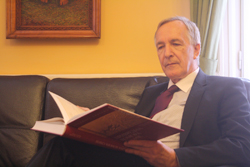
His Excellency Ambassador Boriša Arnaut of Bosnia and Herzegovina to Serbia
Bosnia and Herzegovina
"We must not forget the past, but we cannot live in it." - H.E. Boriša Arnaut
Bosnia and Herzegovina is a country in Southeast Europe, located in the western part of the Balkan Peninsula. It borders Croatia to the north, west and south, and Serbia and Montenegro to the east. The capital city is Sarajevo.
It gained independence on April 5, 1992, following the break-up of the former Yugoslavia. According to international estimates, there are about 3,950,000 inhabitants.
Bosnia and Herzegovina comprises two entities – The Federation of Bosnia and Herzegovina and Republika Srpska – and one district – Brčko.
The Presidency of Bosnia and Herzegovina has three members (one Bosniak, one Serb and one Croat), who rotate chairmanship during one four-year term. They are elected directly by the people (the Federation chooses the Bosniak and the Croat, and Republika Srpska the Serb).
After Macedonia, Bosnia and Herzegovina was the poorest republic in Socialist Yugoslavia. Agriculture was mostly in private hands, but holdings were small and unprofitable, and food was imported. The consequences of the centrally planned economy can still be seen today – and the main problem is the excessive number of workers in industry. During socialism, the defence industry was forced in Bosnia and Herzegovina, and the republic had a large part of Yugoslavia's plants.
Three years of war destroyed the Bosnian economy and infrastructure, and production fell by 80%.
Today, Bosnia and Herzegovina is making huge steps towards the recovery of the economy, infrastructure and its status in the international community.
It is a country with a large tourism tradition, good and pleasant hosts, excellent cuisine and most of all good entertainment. Posle M
1.Your Excellency, what did you do in your diplomatic career before coming to Serbia (a detail or two about your diplomatic career)?
I am a lawyer by profession, and law permeates almost my entire diplomatic career. Thus, from 1996 I was in the Ministry of Interior of Bosnia and Herzegovina and dealt with international legal and consular matters. Besides leadership duties in the seat in Sarajevo, I worked twice at the Consulate General in Munich. Every diplomatic-consular network must serve the citizens of a country, and consulates are special because they focus on people and care for people, whether we are talking about the routine issue of new documents or difficult life situations, which, unfortunately, many people from Bosnia and Herzegovina, who during and after the war found themselves abroad, experienced.
2.What were relations between Bosnia and Serbia like before, and how are they today?
Our relations have always been good; they always moved forward, just with lesser or greater intensity. Although the top officials of Bosnia and Herzegovina and Serbia are meeting regularly, I always think we need even more meetings. Only through talks can open issues be solved and new doors to cooperation opened.
3.What was your first impression when you came to Serbia? What were the similarities between our nations that dominated your impressions, and what were the differences?
My impressions were positive.What struck me immediately was the warmness and goodwill of the people. I remember Belgrade from my student days, when I came to visit friends from Belgrade, and we would go to concerts or matches, and then they would come and visit me in Sarajevo.
The closeness of Sarajevo and Belgrade has a long tradition. Belgrade has changed a lot from what it was before. It has become a large city and everything happens here quickly. Although Sarajevo has also undergone similar changes in terms of growth in population and urbanisation, everything happens there somewhat more quietly and slowly. Sarajevo in this sense has retained its recognisable spirit.
I am fascinated by the diversity that exists in Belgrade. Belgrade really has a heart for all. Everybody is welcome here.
4.Of your impressions of Serbia, which do you see as an advantage and which as a possible obstacle in the bilateral relations of these two countries?
There are many nice and a few difficult issues in the two countries' relations. Let’s start with ourselves. All that we want is good health and a good outlook for our children.
If we constantly go through the dark tunnels of the not-so-distant past, I'm afraid this won't bring anyone better work, better pay, a roof over their head or a summer holiday.
We must not forget the past, but we cannot live in it.
Europe has been the scene of the bloodiest battles in recent history, and countries which were once at war today sit at the same table where we also want a place for ourselves. Time needs to pass and new generations who will more easily bear the burden of the past until it's completely behind them need to come of age.
The potentials of our cooperation are huge, in all spheres of life. We must look at the moment and to the future, we must be pragmatic and constructive, because we are where we are and we cannot choose our neighbours.
5.Which segment of cooperation would you highlight as special, which is exceptionally well developed and with visible results, and what is it that we need to work on additionally and intensively?
Although there is huge potential, economic cooperation is well developed. We must bear in mind that we have all been hit by the economic crisis and that our expectations must be tailored to real possibilities. On the other hand, the time of crisis is also an opportunity to identify key fields which could lead the future development of our cooperation. We all have limited resources and we should use them cleverly. Improving economic cooperation should be aimed at networking sectors, implementing joint projects and entering third markets. I'd better not forget to mention culture and art because they are fields in which Bosnia and Herzegovina and Serbia have very rich and intensive cooperation.
6.How do you see the economic relations between Bosnia and Herzegovina and Serbia? Is this cooperation active at full capacity? How can it be improved?
As I said, our economic relations are good. Despite the consequences of the financial and economic crisis, mutual trade flows are relatively stable. These trends show that there are untapped opportunities for further expansion and diversification of overall bilateral economic and trade relations. At the recently held meeting of the Joint Commission for Economic Cooperation between Bosnia and Herzegovina and Serbia, a kind of inventory of economic cooperation per field was created, from trade, investment, agriculture, energy, transport and communications to environmental protection, cross-border cooperation and entering third markets.
Measures for abolishing non-tariff barriers to trade, taking place as part of the 2006 multilateral CEFTA free trade agreement, were discussed. Frequent meetings between trade ministers were agreed, so the next one will be mid next year in Sarajevo, when a business forum for business people from both countries will also be held. It’s important that there is good institutional cooperation, exchange of information and agility in solving problems. The meeting of the Joint Commission for Economic Cooperation showed that we have a very good foundation and I am certain that the very concrete agreements from that meeting will be implemented.
7.To what extent are investors from Bosnia and Herzegovina interested in the Serbian market? What is most attractive for them here?
Business people from Bosnia and Herzegovina are interested in the Serbian market primarily because it is close and known from before. The number of people who have revived old business relations with partners from Serbia is not small. The Embassy of Bosnia and Herzegovina in Belgrade is mostly contacted by firms from Bosnia and Herzegovina and Serbia who are seeking buyers, distributors or production sub-contractors in the other country. But the number of these enquiries is not to the same extent to which we would like to help and provide information. I suppose the economic crisis is taking its toll so there is not a lot of expanding business. On the other had, the proximity of our countries and people means the Embassy is not a necessary link in the chain, so I'm sure that a lot of contact takes place without us.
What I can say with certainty is that there are many foreign products in shops in Serbia and products from Bosnia and Herzegovina can find their place among the diverse offering. Here I see one shortcoming on our part, and that is the insufficient number of brands, whether products or companies from Bosnia and Herzegovina, which could compete with goods from other countries.
8.Could you give us some examples of successful business people from Bosnia and Herzegovina in Serbia?
The largest investor from Bosnia and Herzegovina in Serbia is the firm Integral Inženjering (‘Integral Engineering’), which bought the firm Komgrap Belgrade.However, among the more successful business people there are many who have moved from Bosnia and Herzegovina to Belgrade and have been developing their businesses for a long number of years. Today it is very difficult to draw a line in terms of affiliation to this or that country, so I can say there are many successful business people from Bosnia and Herzegovina in Serbia.
9.What are the economic branches that have potential for mutual successful cooperation?
Business people are interested in renewing and establishing long-term production cooperation and other forms of business cooperation. The greatest potential for developing several forms of cooperation is in the metal processing industry, the fruit and vegetable processing industry, meat and milk processing, production of civil engineering machinery, motors, car parts and tractors, the production of equipment for the electric power industry and in the automobile industry.
Our opportunity lies in joint entries into the markets of Iraq or Libya, particularly Iraq where large infrastructure project tenders are in progress. Our firms are known there and enjoy great respect. Such a position should be used and we should tender for jobs. The same applies to the military industry because we were all once part of a large system. Now we need to recognise what of that has remained good and of high quality and reconnect into a new unit.
10.What can Bosnia and Herzegovina offer Serbian investors? Is there already interest among local business people for the Bosnian market?
The market of Bosnia and Herzegovina has long been attractive for Serbian investors. Bosnia and Herzegovina has a good workforce, natural resources, production capacities and a currency tied to the euro. The largest individual investment in Bosnia and Herzegovina comes from Serbia, and this is the purchase of Telekomunikacije Republike Srpske a.d. Banja Luka by Telekom Serbia in 2007 for EUR 646 million.Serbia is the second largest individual investor in Bosnia and Herzegovina.
11.What is the key element which makes business people from these two countries cooperate with each other?
Bosnia and Herzegovina and Serbia have rounded contractual relations in the field of economic cooperation, thus, there exists a legal framework. The proximity of Sarajevo and Belgrade also means officials can meet more frequently and talk about all current topics. Economic relations and how to improve them are one of these topics that are always current. The closeness of the markets, lack of a language barrier and a tradition of business certainly encourages our business people to cooperate. Strong ties between the two economies date back to the time of the former Yugoslavia. Accordingly, it is not strange that these ties are being renewed, that complementary capacities are being connected and business cooperation is being re-established.
12.Do you believe that the EU integration of Serbia will accelerate our relations? How do you see this process and its benefits and risks for the country individually and the region as a whole?
I must say that I am an advocate of the argument that we ourselves must recognise our interests and needs, and fulfil them for ourselves and not because this or that is required of us.
European integration is a foreign policy priority of both countries. On this path, we must help one another because we each understand well the position of the other. We must be better for ourselves, not because of European Union demands. Everything we come up with and do together will be welcomed and supported by Europe.
I believe in our people, I believe that we have good ideas, expertise and the capacity to achieve a lot of this. I see the process of adaptation to the European Union as a process of adapting to high standards in all areas of life. But, besides this, we are expected to solve all of our open issues. The European Union does not want problems rather it wants in its club the countries which can contribute to the common good.
I believe that through the European Union integration process we will be transformed for the better, both as societies and countries, so that we are good and useful to ourselves, our loved ones, our neighbours and all of society.
13.What are our relations like as far as culture and art are concerned and what plans are there?
Culture and art are always at the forefront and I am of the opinion that they have exceptional importance in improving bilateral relations. They know no boundaries and this is illustrated in the example of our two countries and the achieved cooperation between theatres, fairs, festivals, cultural institutions, libraries, archives, cultural and artistic societies, sports associations and the like. It’s really impossible to count them all and I’m happy that the cooperation is so wide and substantial. I must add that little money, and unfortunately less and less of it, is earmarked for supporting culture and art in Bosnia and Herzegovina and Serbia. Culture enriches us, connects us and makes us better people. Culture and art truly build new bridges between people, cities and states.
14.How do you spend your free time in Belgrade? Do you have a favourite place? What do you intend to take from Belgrade/Serbia as your favourite memory of the days spent here?
As a diplomat, I have very little free time. I often have obligations over the weekend, but they are certainly more pleasant than those during the work week.
I go to the theatre, to concerts, exhibitions and, of course, to good restaurants of which there are many. Belgrade’s cultural life is dynamic and rich so I try to ensure that my wife and I, both lovers of good performances, regularly go to the theatre.
Not infrequently do I travel around Serbia with my family and visit even the remotest of areas. I regularly go to Fruška Gora where, besides enjoying the nature, I tour the estates and purchase domestic produce for my own needs: fruit, vegetables, juices and wine.
I managed to significantly expand my book collection in Serbia so I’ve no need to worry about what I’ll do after the end of my term for at least a few months. I am a lover of fine art. Besides small souvenirs, I’m taking several works of art with motifs of Belgrade and Serbia which will find a place on the walls in my home, and remind me of the nice days I spent in Serbia.
15.What obligations will you leave your “successor”? What do you think the next important steps are in relations between Bosnia and Herzegovina?
Every diplomatic representative of Bosnia and Herzegovina in Serbia has the task of offering his contribution to improving overall bilateral relations.
I would like open issues to be resolved during the term of the next ambassador, and for the Agreement on the Extension of the State Border to be signed. Also, I’d like the procedure for solving the succession issue to speed up and, above all, the return of the property of Bosnian and Herzegovinian companies located in the territory of Serbia, as well for permanent solutions to be found for some border crossings.
Political will is needed, but also specific initiatives by both administrations and I am sure that everything can be finished to the satisfaction of both sides.
Time is working against us, because some issues become more complicated over the passage of time, and all of this together does not bring us closer to European integration. Once these complex but essentially basic problems are solved, we will have cleared a huge amount of room for specific things. Furthermore, there would be political relaxation on both sides and that would be the right moment for us to raise our bilateral relations to a higher, more quality level.


