


Interview
Ornelo Baron
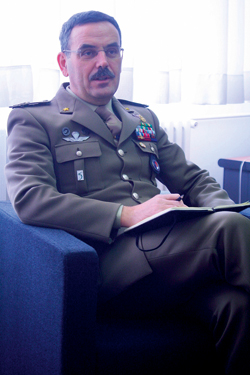
Brigadier General Ornello Baron, the Chief of the NATO Military Liaison Office in Belgrade, Serbia
The North Atlantic Alliance
“NATO is improving Serbia’s security through its presence in the region and assistance in developing a flexible, modern, and sustainable defence system.” Brigadier General Ornello Baron
NATO – The North Atlantic Treaty Organisation was established on April 4, 1949, with the signing of North Atlantic Treaty. NATO is also known as the North Atlantic Alliance. According to the official NATO website, its fundamental purpose is to safeguard the freedom and security of its members through political and military means and to provide a unique transatlantic link for political and security cooperation. Although much has changed since its founding in 1949, the Alliance remains an essential and unique source of stability in an unpredictable geopolitical environment.
It is also noted that “NATO members now confront a far broader spectrum of security challenges than in the past.”
Today, NATO comprises 28 member countries from North America and Europe. The newest members are Albania and Croatia, which joined in April 2009.
Twenty-two additional countries participate in the NATO Partnership for Peace programme, Serbia being one of them, while 15 other countries have been involved in institutionalised dialogue programmes.
The cooperation between NATO and Serbia takes place through the NATO Military Liaison Office in Belgrade which belongs to NATO Allied Joint Force Command Naples.
The NATO Military Liaison Office in Belgrade has been a vital contact point between the Serbian Ministry of Defence and NATO since it was established in December 2006.
The office facilitates Serbian cooperation with NATO under the Partnership for Peace programme and supports Serbia’s efforts in matters of defence sector reform through the joint Serbia-NATO Defence Reform Group. The MLO also provides assistance to NATO’s public diplomacy activities in the region, and serves as a link with the military authorities of Serbia on the practical aspects of the implementation of the Transit Agreement.
Italian Brigadier General Ornello Baron has been the Chief of the NATO MLO since February 2012.
We have been truly honoured to speak with Brigadier General Ornello Baron, the Chief of the NATO Military Liaison Office in Belgrade, Serbia.
General Baron, how do you feel in our country and what kind of impressions have you acquired of Belgrade during your stay here?
First of all, I want to say that I am very happy to be here in Serbia as Chief of NATO’s MLO Office and I am glad that I can personally contribute to the rising cooperation between Serbia and NATO. Belgrade is a great city to live in, very vibrant and diverse, and the spirit of your people reminds me of my homeland, Italy. I had an opportunity to travel around Serbia and I was especially enchanted by the beauty of the Serbian monasteries.
When did you arrive in Serbia and what was your career like prior to your arrival?
I came to Serbia in February 2012 when I took over the duty from the previous Chief of NATO MLO, Brigadier General Mauro De Vincentis. Prior to this, I had gained several years of professional experience in the Balkans as the Defence Attaché in Slovenia and KFOR unit Commander in Kosovo. I had also served in Afghanistan and several different commands and units in Italy. This is my first time dealing with the Serbian Armed Forces, and I have to say I am very glad to have met such skilful and professional soldiers.
SLIKA IZ MANASTIRA DECANI
TEXT BOX1
Securing cultural heritage sites is one of the main tasks of KFOR and an opportunity to meet members of the high clergy and the spiritual leaders of the community.
How was your experience as NATO-KFOR Commander?
I did a tour in Kosovo in 2005-2006 as the Commander of Task Force “Aquila”. My area of responsibility covered several municipalities in the western part of Kosovo. My main task at that time was to maintain a safe and secure environment throughout the area and in particular to guard the monasteries and cultural heritage. This was an opportunity for me to often meet the local population, authorities and the monks from Decani Monastery, one of them being Bishop Teodosije, the Abbot, whom I had a chance to spend some time with on several occasions
SLIKE SA KOSOVA – JEDNA DA BUDE ONA KOJA U NAZIVU SADRZI “Kosovo - to carry out the task of providing safety for all, a soldier must know the terrain”
How would you describe the current cooperation between NATO and Serbia?
TEXT BOX 4
Through active PfP participation, the Republic of Serbia demonstrates its readiness to continue cooperating with NATO and its member states, as well bilaterally cooperate with other partner countries.
Nowadays, defence sector reform remains the core element of our cooperation. An important vehicle for this cooperation has been the Serbia-NATO Defence Reform Group, which has intensified its activities in the past two years, and a special team from Brussels that checks the state of reforms on a quarterly basis. I have to underline that progress up until this point has been commendable.
In addition, NATO is assisting the Serbian Ministry of Defence in other fields such as reducing the risk of corruption through the NATO Building Integrity initiative. Ambassador Jan Lucas van Hoorn from NATO has been a frequent guest here in Belgrade, providing assistance in this matter.
TEXT BOX 6
NATO assists the Serbian Defence Ministry in reducing corruption risks and General Baron believes that NATO’s anti-corruption expertise will be particularly valuable to the new government as it puts fighting corruption at the top of its agenda.
What are the most recent activities within the PfP programme?
Our most recent significant activity was in September 2012 when more than 30 officers from NATO and partner countries came to Sombor to evaluate the Serbian units selected to participate in peacekeeping operations, in terms of our standards and requirements under the so-called NATO Operational Capabilities Concept. The exercise involved more than 400 Serbian soldiers from infantry, military police, and chemical, biological, radiological and nuclear (CBRN) units, who simulated a real operation scenario in English, using NATO tactical procedures and modern equipment. When this programme finishes in 2014, those units will be NATO-certified to take part in any international mission.
TEXT BOX 7
400 Serbian solders will be NATO-certified and able to take a part in all international missions in 2014.
Furthermore, NATO and its members are involved in improving Serbian capacities at the Technical Overhauling Institute in Kragujevac and the CBRN Centre in Krusevac. When the projects are finished, these facilities will be able to become regional centres for cooperation in defence matters.
How is the NATO Military Liaison Office involved in these activities and what is its core mission?
The NATO Military Liaison Office in Belgrade is a vital contact point between the Serbian Ministry of Defence and NATO as it facilitates all mentioned aspects of Serbia’s cooperation with NATO under the Partnership for Peace framework.
We are looking forward to enhancing our relations soon when the Individual Partnership Action Plan (IPAP), the next important step in NATO-Serbia relations, is agreed between the two sides. This plan will expand our cooperation to include political and security issues, public information, science and environment, as well as crisis management and emergency planning.
How many staff currently work in the MLO in Belgrade?
We have a total of six military staff and four local civilians employed in the Military Liaison Office in Belgrade. I would like to underline that the military personnel come from different countries like Italy, Greece, Slovenia, and until very recently Germany
Two Warrant Officers from Italy, who also have experience abroad, are assisting me. One of them in particular, WO Ferlicca, has operational experience serving as a pilot in Bosnia and Afghanistan. The international military expertise is a valuable asset for the office.
You mentioned that you have Serbian employees on your staff, what is their role in your office?
At the moment I have four Serbian civilian staff members working for the office as interpreters, one as the Country Advisor and another as the Media Advisor. The two advisors joined the team recently when the new public affairs cell was established and their positions opened. All of them are very skilful and were selected from hundreds of candidates. I am very confident that the newest MLO cell will help me further improve our future activities and understanding of NATO in Serbia.
What should an ordinary citizen of this country know about the benefits and impacts of NATO cooperation?
People don’t generally associate NATO with global security threats such as terrorism, cyber defence, proliferation of weapons of mass destruction or piracy, but this is exactly what NATO is dealing with. NATO’s operations in the Mediterranean and Afghanistan have a strong focus on counter terrorism, and individual Allied nations’ projects help our partners meet urgent security needs.
Could you give us some examples of these activities?
One such example is the Stand-Off Detection of Explosives (STANDEX) Programme, to detect and prevent terrorist attacks in large public areas such as airports or metro stations. Another important cooperation project with Russia aims to prevent terrorist attacks using civilian aircraft, such as the 9/11 attacks against the United States. The Alliance is also working with partners all around the world to contribute to energy security and ensure that transit and international trade routes are resilient against attacks or disruption.
Serbia shares all these risks, and no country in today’s world can cope with them independently – thus information sharing cooperation and partnerships are necessary.
What will the strongest memory of your stay here be?
TEXT BOX 12
I know that I will never forget the hospitality of your people, nor the many friends that I have made here.
Being an Italian, it was very easy for me to get used to Serbian cuisine, and I am particularly happy that you make great Italian food. I often go to Ada Ciganlija for jogging, and I enjoy taking strolls in Kalemegdan and dining with friends at one of many great restaurants in Zemun. My family loves to come here and they often visit me to go out or travel around Serbia where I enjoy local traditions and beautiful landscapes. I still have several places that I plan to visit and I hope I will be able to do so by the time my mandate ends in spring 2014.
TEXT BOX 14
Brigadier General Ornello Baron was born on January 3, 1959, in Castelfranco Veneto. General Baron holds Airborne and Special Patrolling badges and a degree in Strategic Military Studies with a Master’s Degree in Strategic Military Sciences. He has held the title of Brigadier General since 2009. He possesses numerous awards and decorations: the Italian Medal for Peace in Afghanistan, the Italian Peacekeeping Commemorative Medal, the NATO Mission Commemorative Medal in Kosovo, the United States Bronze Star Medal and the German Sportabzeichen medal are just few of them. He is married to Mrs. Lorenza and he has three children, Gioia, Yuri and Lisa.


