


Ambassador
Belarus
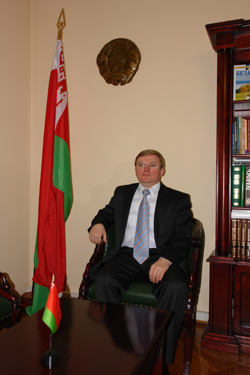
His Excellency, the Ambassador of Belarus to Serbia, Vladimir Čušev
The Republic of Belarus
The Republic of Belarus is a landlocked European country. It borders with Russia in the Northeast, Ukraine in the South, Poland and Lithuania in the West, and Latvia in the Northwest.
The capital and the largest city is Minsk.
Most of the Belarusian population lives in urban areas, as well as in and around large cities.
Over 80 % of the population are Belarusians by ethnic origin, whereas the largest minority communities are Russians,Poles and Ukrainians. Official languages are the Belarusian and Russian language.
In terms of religions, the largest percentage of the population are the followers of the Russian Orthodox Church, and in the western part of the country live smaller communities of Roman Catholics.
Over 25 % of the territory, out of the total of 207,600 km², is covered by forests, and the most important sources of income are agriculture and industry.
Belarus is an independent country with strong industry, modern infrastructure and beautiful nature which has been preserved in its original beauty in nature reserves and protected areas. In this country live compassionate and friendly people of different ethnic origins and religious beliefs. They have been preserving the history of their country and working diligently on its development, both in the present and future times.Belarus is a country with an open market economy whose goods are directed towards the social development of the society and all the citizens. A high standard of living, security and social care of the citizens are the main objectives of the policy of Belarus as a state.
Belarusian SSR was one of the founders of the UN, together with the USSR andUkrainian SSR.
The Republic of Belarus is an export-oriented country with developed industry, agriculture and the field of services.The main branches of Belarusian industry are: light industry, construction industry, agricultural industry, forestry and wood industry, machine building and metal processing industry, chemical and petroleum industry, as well as the fuels and energy sector.
The main agricultural products are potatoes, flex, hemp, sugar beets, oaths,rye and wheat, whereas in terms of animal husbandry, the prevailing fields are dairy and meat cattle breeding, and pig and chicken farming.
Belarusian traditional cuisine is based on the abundance of vegetables, meat (mostly pork) and bread. The most popular drinks are vodka and kvass.
As a sign of welcome, a host traditionally greets his guest with bread and salt.
We had the pleasure and honour to talk about beautiful, friendly and brotherly Belarus with His Excellency, the Ambassador of Belarus to Serbia, Vladimir Čušev.
1. Your Excellency, you have served as an ambassador to Serbia since 2011. What have been your impressions of Serbia so far?
I have been working as the Ambassador of Belarus since September 2011. Since I have been on this position, I have visited different cities and regions in Serbia: Novi Sad, Subotica, Kragujevac, Kruševac, Kraljevo, Valjevo, Vršac, Novi Pazar, Petrovac na Mlavi, Požarevac, Smederevo, Sremska Mitrovica, Topola and Čačak. I have met with the leaders of these cities and municipalities as well as of the Autonomous Province of Vojvodina.
Last year, I spent Christmas in the Serbian Province of Kosovo and Metohija, in the Patriarchate of Peć.
Fifteen years ago, I came to Belgrade for the first time officially, to participate in the preparations for the signing of an agreement, which was part of the visit of the President of Belarus to the Federal Republic of Yugoslavia. This is how I started to learn about Serbia. After this, I worked here as a counsellor and as a consul in the Belarusian diplomatic mission, and together with the citizens of Serbia, I experienced 78 tragic days and nights of the NATO aggression in 1999. I saw the suffering and courage of the Serbian people. One cannot forget this.
Today, all of my impressions of this country are positive. Serbia is beautiful and diverse.
I like your and my Serbia – the Orthodox and Slavic sister of Belarus.
I am also very fond of the brotherly Serbian people. I have a lot of friends here, and my family is also here with me. We have several people in our embassy who have been to Serbia before. And they like it, too. This creates good working atmosphere.
I would like to take the opportunity to congratulate all the people on the national holiday - the Statehood Day, and to wish peace and prosperity to every family.
2. What was your diplomatic career like before taking up the position of an ambassador in our country?
After I finished my studies, I worked in the education system for several years, and came to the Ministry of Foreign Affairs in 1995. First I was employed in the Contracts and Legal Affairs Department, and then I was sent to the Embassy of Belarus in Yugoslavia. When I returned to the Ministry of Foreign Trade, I became the head of the Directorate for International Agreements. I continued to work in the diplomatic service in Warsaw, as the Deputy Ambassador of Belarus. After this, I went back again to the MFA and served there as the Director of the Contracts and Legal Affairs Department, until I re-visited Belgrade. During my diplomatic service, I have had opportunities to stay in many countries, however, Serbia holds a special place in my heart.
I would like to remind that, next year, we are celebrating an anniversary – 20 years since the establishment of diplomatic relations between our two countries.
In 1945, Belarus and Yugoslavia were among the original members of the UN. Today, Belarus has diplomatic relations with 172 countries, and in 50 of them we have opened diplomatic and consular representative offices. As a legal practitioner, I have noticed that Belarus signed about 3600 international agreements, and over 2000 of them were bilateral agreements and about 1550 multilateral agreements. It should be said that 24 agreements make the contractual and legal basis of Belarus-Serbia relations.
3. What are current diplomatic and political relations between Belarus and Serbia, what were they like in the past?
Belarus and Serbia are connected through a number of factors, including common historical and cultural roots, the Slavic script and the Orthodox religion. There have never been any disagreements between our nations. Moreover, we are connected with brotherly feelings.
Diplomatic relations between the Republic of Belarus and the Federal Republic of Yugoslavia (FRY), whose legal successors were Serbia and Montenegro from February 2003, and the Republic of Serbia from June 2006, were established on 15 November 1994.
In 1996, the Embassy of Belarus was opened in Belgrade and the Embassy of Serbia/Yugoslavia in Minsk.
Today, Belarus-Serbian relations are developing, however, the current situation does not match the existing potentials and expectations of our people.
The President of the Republic of Belarus, A. Lukashenko, made a contribution to the development of bilateral relations in a working visit to Serbia in March 2009. During the visit, meetings were held with the leadership of the Government of the Republic of Serbia where conditions for activating the trade and economic cooperation were created.
Belarus consistently supports Serbia on the issues concerning Kosovo and Metohija. By not acknowledging the independence of Kosovo, Belarus not only supports the Serbian initiative in international organisations, but also appeared in the UN International Court.
Belarus supported Serbia in the elections for the UNESCO Intergovernmental Committee for the Safeguarding of the Intangible Cultural Heritage. For Serbia is very important to be part of this Committee for the purposes of protection of the Serbian cultural heritage in Kosovo.
Our country voted for Serbian candidates on the elections for the President of the 67th Session of the UN General Assembly, UN Committee for the Elimination of Discrimination Against Women, and Executive Council of the UN World Tourism Organisation (UNWTO) for 2013-2017.
Serbia supported Belarus in the elections for the members of EKOSOS.
These are good examples of mutual cooperation between our countries in the international segment.
However, in recent years, the Serbian side has supported negative statements and opinions of the EU towards Belarus in the international organisations – the OSCE Permanent Council, the European Council, the Secretariat for Human Rights, the General Assembly and the UN Third Committee. Such practice cannot contribute to the development of cooperation between Belarus and Serbia in the international organisations, and this harms bilateral relations on the whole.
We welcome the interest of the new Serbian leadership in the development of relations with our country on a pragmatic and mutually advantageous basis, emphasising the economic cooperation. This has already been proven with positive trends in the bilateral cooperation in the second half of 2012.
The ministers of foreign affairs of Belarus and Serbia held a working meeting during the Non-Aligned Movement Summit in August in Teheran.
The maintaining and development of positive trends in dialogues on foreign policy were supported by consultations between the ministries of foreign affairs, held in September, after a three-year break.
In September, the President of the Commercial Appellate Court of Serbia, M. Nikolić, visited Belarus. During his visit, they signed a cooperation agreement with the Higher Economic Court of Belarus.
During an October visit to Minsk by the Minister of Culture and Information of Serbia, B. Petković, they signed a cooperation program with the Ministry of Culture of Belarus. It was agreed to organise Days of Serbian Culture in Belarus, in 2013, and Days of Belarus Culture in Serbia, in 2014. Minister B. Petković had a meeting with the Deputy Prime Minister of Belarus and the heads of the Ministry of Culture and the Ministry of Information of Belarus.
A representative Serbian delegation, consisting of the Minister of Construction and Urban Planning of Serbia and the members of the Assembly, attended the 7th Belarusian Investment Forum in Minsk, in November 2012. The Serbian Assembly members, who attended the Forum, met with the heads of the Foreign Affairs Committees of the House of Representatives and of the Council of the Republic of Belarus.
Belarus and Serbia have a developed contractual and legal basis of the bilateral cooperation. The parties are considering several more projects, i.e. projects for the fight against crime and for the legal aid.
We are pleased that the Assembly of Serbia passed a decision on obtaining the status of an observer in the Parliamentary Assembly of the Collective Security Treaty Organisation. This will contribute to the inter-assembly cooperation of Serbia and CSTO member states, including Belarus. The development of relations between Belarus and Serbia will be supported by the establishment of the Group on Cooperation with Belarus in the National Assembly of Serbia. The Group will count 20 members and be headed by D. Karić, a representative of the Belarusian Chamber of Commerce in Serbia.
Inter-regional cooperation has been actively developing as well. The Belarusian-Serbian Friendship Association in Belgrade and the Russian-Belarusian-Serbian Friendship Association in Čačak were founded. Brotherly and partner relations were established between the cities of Mogilev and Kragujevac, Gomel and Novi Sad, Grodno and Kraljevo, Zaslawye and Topola, Nesviz region and the municipality of Zemun.
The issues of establishing cooperation between the following cities have been considered: Minsk and Belgrade, Brest and Subotica, Bobruysk and Kruševac, Polotsk and Sremska Mitrovica, Molodečno and Valjevo, Barysaw and Požarevac, Salihorsk and Jagodina, Zhlobin and Smederevo, Mozyr and Vršac. The signing of a cooperation agreement between the Gomelsk region and the Autonomous Province of Vojvodina is under way.
Serbian public authorities are carrying out a candidate compliance procedure for Serbian businessmen, proposed by the Belarusian side, for the position of honorary consuls of the Republic of Belarus in Serbia - in the Autonomous Province of Vojvodina and in the Šumadija region.
4. Since 2009, Belarus and Serbia initiated intensive economic cooperation and signed the Free Trade Agreement. At what level is the economic cooperation between the two countries today and what has been the contribution of this Agreement?
I must say that Belarus is a useful and a stable partner for Serbia in foreign trade. We have almost the same export-import amount, we actively exchange technology, and a large part of the trade in goods make products with a high added value.
In 2012, Belarus continued with its gradual development – the gross domestic product increased by 15%, export by 13,3%, production of industrial products by 5,7%, and citizens income by 20,4%. The registered unemployment level was 0.5% at the end of December 2012.
After the signing of the Free Trade Agreement between the Government of the Republic of Belarus and the Government of the Republic of Serbia on 1 March 2009, the turnover increased almost double, up to USD 150 mill. In 2012, we continued with trade diversification, the share of finished goods exported from Belarus increased, and Belarusian manufacturers carried out a delivery of their products to the Serbian market through a number of large tenders. There are examples of good operation of Belarusian machines – “Belarus” tractors, “Belkommunmash” trolley busses in Belgrade, MAZ buses in different Serbian cities, and BelAZ dumper-trucks in large mines in the country.
Serbia is participating in the implementation of a number of construction projects in Belarus. Belarus founded 2 companies: a tractor assembling company in Novi Sad and a bus assembling company in Kragujevac.
At the same time, according to the foreign trade turnover of Belarus, Serbia was on the 42nd place last year, with a share of 0.16%. This proves that we have significant opportunities to increase bilateral trade and cooperation in the production and exchange of technology.
5. Are investors from Belarus interested in investments in Serbia and in what areas, and do Serbian investors invest in Belarus? Are there any specific projects between Belarusian and Serbian companies that are under way?
The most important direction of the economic policy of the Republic of Belarus is to create a favourable investment climate for attracting and efficiently utilising foreign investments.
Competitive advantages are based on the political and economic stability, on the geographic location, character and structure of production, labour qualifications and costs, existence of developed scientific and innovation centers, and preferential regimes with exemptions, including the income tax and VAT up to 15 year.
Being part of the Common Economic Zone (CEZ) with Russia and Kazakhstan, for Belarus this means favourable conditions for access to raw materials and financial resources. In doing business with Belarus, Serbia has gained direct access to the 170 million people market for the three CEZ countries.
Today, our country is a leader in legislation development, which was confirmed by the research “Doing Business-2013” (DB), conducted by the World Bank . In comparison to 2012, Belarus has improved its DB rating for 11 points. In the end Belarus was 58th among 185 countries, on the basis of business conditions, and, thus, superseded Russia and Ukraine.
According to the indicators such as “registration of property” (3rd place) and “starting a business” (9th place), Belarus is one of the most attractive countries not only in the region but also in the whole world.
Currently, the investment cooperation between our two countries is poorly developed. We have also noticed a significant mutual interest of potential investors from the two countries in the implementation of joint projects both in Serbia and in Belarus.
The company “Amkodor”, being a part of development of the production and scientific/technological cooperation, deals with the purchase of three or more factories in Serbia in 2013. They plan to deliver products to the markets of the Customs Union countries with which Serbia signed free trade agreements.
Serbian partners are interested in the implementation of the projects in the field of agriculture, production of food products, juices and construction materials. A joint production of tyres, together with the company “Trayal Corporation”, is being developed in the company “Belšina”.
In Belarus was founded the National Agency for Investments and Privatization, which will help a potential Serbian investor chose a project, obtain land/sector for the implementation of a project and carry out all the necessary formalities. I would like to repeat that partners also receive necessary information and full support by the Belarusian Embassy in Belgrade.
6. At the end of last year, the ministries of cultures of the two countries signed the Program of Cooperation within the Field of Culture and Arts until 2017. What is envisaged by this Program and what specifically will be completed this year in the field of cultural cooperation between the two countries?
The Program of Cooperation within the Field of Culture and Arts envisages strengthening of contacts between the two countries in the field of music and theatre art, film art, museum and exhibition activities, preservation of historical and cultural values, library activities, etc.
In 2005, the Days of Belarusian Culture were held in Serbia. The Serbian side showed interested in organising the Days of Serbian Culture in Belarus, however, it never sent specific proposals for organising the event until the Minsk visit of the Serbian Minister of Culture, B. Petković, in October 2012.
It was agreed, as part of the signed Program of Cooperation, to organise the Days of Serbian Culture in Belarus in 2013, and the Days of Belarus Culture in Serbia in 2014. The organisation of the Days of the Serbian Movie in Belarus is under consideration, as well as exchange of online book catalogues between the national libraries.
The publishing companies “Belarusian Encyclopedia” and “Belles Lettres” participated in the 57th International Book Fair in October in Belgrade. During the meeting of the representatives of the Belarusian publishing houses, they discussed about the possibility of continuing with the publication of Serbian books in Belarus and Belarusian books in Serbia. In February 2013, the Serbian delegation will participate in the International Book Fair in Minsk.
7. What is, in your opinion, the European future of Serbia? Will the Serbia’s membership in the European Union affect the relations between Belarus and Serbia?
Serbia and Belarus are European countries. Consequently, the past and future of Serbian and Belarusian nations is European. It is impossible to move our territories to America, Asia or Africa even if we wanted to.
The European Union, which brings together 27 out of 44 European countries, embodies a natural desire of European nations to unite under globalisation conditions. We respect Serbia’s wish to participate in the project, even if we take into consideration that the idea is not yet supported by the majority of Serbian citizens, according to a poll.
Belarus decided to participate in the second integration project which is currently bringing together European Belarus, Euroasian Russia and Asian Kazakhstan. Our three countries are already united in the Customs Union and in the Single Economic Zone. In January 2015, the Euroasian Economic Community (EEC) will start with its operation. The membership in this integration project is open for all the interested countries willing to accept and meet the requirements of the EEC membership, including submission of a part of authorisation to the EEC and provision of financial, personnel and other contributions required for the operation of the Community. The Euroasian Economic Community, created according to the principles of the World Trade Organisation, and considering the experience of the European Union, is a large solvent market with over 170 million people. We hope that the supranational EEC and EU bodies will contribute to the expansion of trade, investment and other types of cooperation of Belarus, Kazakhstan and Russia with the EU countries.
Unfortunately, the European Union is currently putting Belarus under pressure. On no reasonable grounds and violating the international law, it is banning some Belarusian citizens from entering into the EU, and it has also envisaged freezing of financial resources for several Belarusian companies. We would like to emphasise that the policy of double standards and sanctions is hopeless and counterproductive.
Regardless of its distant perspective of entering into the EU, Serbia has supported all EU decisions on foreign trade policy and security, including restrictive measures against Belarus. This is a negative aspect of our relations.
By supporting unilateral restrictive measures of the EU towards Belarus, and by deciding to “freeze” funds for a number of Belarusian commercial organisations, the Serbian side violated Article 14 of the Agreement between the Government of the Republic of Belarus and the Government of the Republic of Serbia on Free Trade between the Republic of Belarus and the Republic of Serbia of 31 March 2009, which does not envisage payments for the trade in goods and transfer of these payments. Actually, the Serbian party unilaterally extended a list of exemptions from the free trade regime by entering a number of Belarusian companies. Restriction of the freedom of transfer of payments has created a negative atmosphere for the bilateral trade.
We are treating a complex Serbian situation in the foreign trade policy with understanding. However, we hope that Serbia will eventually find a way to refuse to support the sanctions imposed by the European Union on the Republic of Belarus. Belarus did not deserve them because Belarusian people have always been and will be sincere friends to Serbian people, and Belarus will always be a reliable partner for Serbia.
8. How would you present Belarus as a tourist destination? What would you tell us about your country? Is Serbia, and to what extent, an attractive tourist destination for Belarus?
Both Belarus and Serbia are unique and interesting countries in their nature and landscape, history and culture.
Belarus is ready to offer to Serbia its health resorts, hunting and fishing farms, ranches, tours around Orthodox churches and monasteries, and sports and historical tourism.
On the other hand, Belarusian tourists are interested in Serbian ski centers and visiting unique national parks and natural spas.
Neither Belarus nor Serbia have access to the sea and are forced to actively develop their tourism infrastructure. Many things have been done in this segment in the last couple of years.
One should point out that both Serbia and Belarus have little information about tourist potentials of the two countries.
In 2012, the Minister of Sports and Tourism of the Republic of Belarus and the Secretary of State to the Ministry of Economy and Regional Development of the Republic of Serbia held a meeting about tourism. The parties discussed about the issues of establishing cooperation in the field of tourism. They proposed participation at tourism fairs in Belarus and Serbia and consideration of a possibility of providing support to the Belarusian and Serbian media in the form of informative materials revealing tourist potential of the partner country.
The result of the meeting was the signing of the Plan of Cooperation within the Field of Tourism between the Ministry of Sports and Tourism of the Republic of Belarus and the Ministry of Economy and Regional Development of the Republic of Serbia for 2012-2013.
A possibility was also considered to organise a temporary exhibition in Belgrade on Belarusian tourism possibilities. It is also possible to organise an exhibition on Serbian tourism opportunities in Minsk.
If the tourist exchange between the countries increases, it will be possible to discuss seriously about direct flights Belgrade-Minsk-Belgrade.
It should be noted that in 2013, Minsk will be the host of the Cycling World Championship (20-24 February) and the Boxing European Championship (30 May – 9 June), and in 2014, Belarus will be the host of the Hockey World Cup (9-25 May).
Finally, we could point out that both Belarusian and Serbian companies should make every effort to pass the information to all interested people in our countries about available tourism opportunities.
Both sides should be more active in this segment.
9. How do you spend your free time in Belgrade? Do you have favourite places you often visit?
I must admit I do not have a lot of free time. Much attention should be paid to the development of our relations and creation of bilateral contacts. In the evenings and at weekends I often attend many cultural events taking place in Belgrade and in different regions. At the same time, this helps me to learn more about the country, its people, culture and spiritual wealth. Evenings are often occupied by diplomatic events organised by other embassies.
I spend my free time with my family. My favourite places in Belgrade are the National Theatre, the Kalemegdan Fortress, the pedestrian street, and Terazije. I like Sremski Karlovci and Fruška gora and I like spending time at the Petrovaradin Fortress.
10. When you leave from Serbia, what will you definitely take with you?
When the time comes to leave the hospitable Serbia, I will take a few icons I received as gifts, the books about your country, national souvenirs, and wine and rakija for my friends. Of course, I will take beautiful memories of the country and its people. This means new visits to Serbia in the future.


