


Business Thought
Andy Owen
A story of John E. Kennedy, Albert Lasker and why copywriters have to be salesmen…
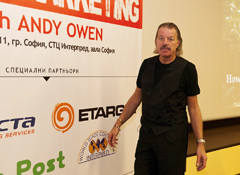
Andy Owen
I can tell you what advertising is!
In Chicago, on a spring day 107 years ago, a 40-year old man walked into the lobby of a top ad agency – Lord & Thomas. He gave a note to the receptionist and asked her to give it to one of the directors.
The note was:
“I am downstairs. I can tell you what advertising is. I know you don't know. It will mean much to me to have you know what it is and it will mean much to you. If you wish to know what advertising is, send the word "yes" down by the bell boy”.
The man was John E. Kennedy.
A junior employee of the firm, Albert Lasker, was asked to receive Kennedy.Unknown to Kennedy, Lasker had been searching for the answer to that question for 7 years. Lasker invited Kennedy to his office. After the usual pleasantries, they got down to talking about advertising and communication.What Kennedy told him that night was simple – and three words within the discussion, ultimately changed advertising forever.
“Advertising, Kennedy told Lasker,” is salesmanship in print. An ad should say in print precisely what a good salesman would say face to face.Instead of general claims, pretty pictures or jingles, an ad should offer a concrete “reason why” the product was worth buying”.
He went on: “An ad should not be charming, amusing or even necessarily pleasing to the eye - a good ad should be a rational, unadorned instrument of selling”.
Copycat
Lasker was transfixed by Kennedy.He was so confident, so assured. He just let him continue, which he did.
“True “reason why” copy is logic, plus persuasion and conviction, all woven into a certain simplicity of thought – pre-digested for the average mind, so that it’s easier to understand than to misunderstand it”.
He added that, “copy is much more than typographical dress”.
To Lasker, this was an epiphany. He had never heard anything so logical, so correct and so right.He knew this was a pivotal moment in his life.Until then, many obscure definitions had been banded about to describe advertising and how to do it.
Perhaps the most famous was the motto of A.J. Ayer, then the leading US agency.
They said to get good advertising you must "Keep everlastingly at it".
Well, I suppose that’s correct. But it was not exactly inspirational stuff. No wonder Lasker wouldn’t let Kennedy go. Unbelievably, they talked until 3am the next morning.
Lasker hired Kennedy as his chief copywriter the next day. His influence was immediate. He wrote ads in a visually distinctive style, hard hitting, with lots of italics and underlining - and they were very successful. Predictably, his style was quickly imitated by other agencies.
Kennedy’s beliefs were soon interwoven into the agency culture. He quickly got all the creatives together in the agency early on - and told them this:
“Advertising should be judged only by the goods it is conclusively known to sell, at a given cost. Keeping the name before the people”, he said, “is wrong – and salesmanship on paper is right”.
Lasker trumpeted the Kennedy approach at every opportunity
His support and belief in the man was total. And, as the results came through, he told a friend over lunch one day that, “we saw more clearly than ever, that basically it is copy that makes advertising pay”.
Once he was established in the agency, Kennedy then decided to write down his principles, so they could be taught to other copywriters in the agency. Kennedy became the highest paid copywriter in history, because his copy made fortunes for his clients. It was reported that he earned a staggering $52,000 a year. This was in 1905!
Today, the only documents that survived with Kennedy's name on them are Reason-Why Advertising, The Book of Advertising Tests (which is basically the same as Reason-Why Advertising, but with a couple of added chapters - one of which is purely promotional and non-instructive in nature), and Intensive Advertising.
Many people have made millions by following Kennedy’s principles. And many more can do the same, if his proven principles are embraced correctly.
But I can tell you, that very few out there today, will bother.Why is this?
I believe it’s because marketers and advertisers today do not think that anything pre-digital has any value in today’s marketplace.
As Steve Harrison pointed out in his superb book “How to do better creative work” - an awful lot of damage was done in this area, by a digital pundit called Seth Godin, in his book “Permission Marketing”. Godin attacked what he called “interruption marketing” – which he described as creative work that aimed at stopping the prospect, by getting their attention and delivering the sales message through traditional channels.
In other words, contemporary direct marketing - an approach that had been hugely successful in its current form for nearly a century and, when done correctly, was still delivering incredible returns for clients.
Godin dismissed all that with a wave of his hand. He suggested that such an approach was not working and would soon be replaced by digitally-led permission marketing.This was the way forward, he predicted.
A lot of people bought it. Agency folk and clients. Of course, this was 1999 - and any article containing the word digital around then, was instantly believed and adopted. More people in marketing were seduced by digital in that 2-year period, than by anything before or since.
At that time, there were many examples of pimply anoraks who had been playing with computer games in their back bedrooms for years, suddenly writing articles or books about digital - and they became gurus overnight.
Well, I can tell you this, Godin was wrong. Miles out. So were a lot of people that piled in after him.And so are the blinkered marketers that believed him then - and, staggeringly, continue to do so now. I see this blinkered attitude for myself personally, many, many times.
Here’s an example of what I mean. When I present Creative and Copy Masterclasses Seminars and Workshops around the world, I always offer the delegates a FREE book at the end of the show. The book is recognized as probably the greatest ever written in our business. It is Scientific Advertising by Claude Hopkins. It was written in 1920. I offer it to everyone in my audiences for FREE.All delegates have to do is email me and request it.I send it to them with no catches. I tell them this at the event and I also read out David’s quote.I do this because I just want them to have the book, as it will help them with the challenges they will be facing now and in the future.
But only about 15% send for it.It is amazing to me.Why don’t the other 85% send for it?It’s a classic and it’s FREE.It’s a book that is relevant to their daily challenges, yet they choose to ignore it. Clearly they are interested in the subject of direct marketing and communication. They wouldn’t be at the event otherwise. But they ignore the opportunity of getting a FREE masterpiece.Explain it to me please – because I simply do not understand it.
Incidentally, Claude Hopkins succeeded Kennedy at Lord & Thomas. He was so talented that Lasker hired him at the then unheard of salary of $185,000 a year - when the dollar was worth 8 times more than it is now - and tax was almost nil. Yes, he was that good.
Let me tell you this as strongly as I can. This book and Kennedy’s before it are totally relevant to today’s marketing challenges. Whatever you may think to the contrary, you are wrong. Very wrong.
Yes, they were written decades ago - and yes, the language and examples are dated. But, readers of these books will learn many of the tested and most effective methods of the most important thing in our business – the art of selling.
What worked then, will almost certainly work now.As has been said many times, but rarely understood – “times change, but people don’t”. The key element of how and why we respond to marketing and promotional messages is the same today, as it was then.How to connect, attract, influence and sell is a specialist talent.
Kennedy and Hopkins had it in spades. And these skills were passed on through the generations, to greats like Caples and Ogilvy and are embraced by current giants, including Drayton, Steve Harrison and Murray Raphel, to name but three.
It’s a rare expertise. And understood by literally a handful of people around the world.An Andy exaggeration? I don’t think so…
Many have made millions by learning from these books. But many more people have lost millions by ignoring them. And that group is growing, because in this business, we have forgotten how to sell.
As Claude Hopkins said, “I consider advertising as dramatic salesmanship”.He was spot on. But why do people ignore this? Why is current advertising and marketing so bad? Because no one studies anymore. No one tests either. And most don’t give a flying fig about either. They simply don’t see, that what you don’t know can hurt you more than you realize.
I am reminded of a quote by another great in our business - Raymond Rubicam. Raymond also became disenchanted with the business and the quality of work he was seeing. He said, many years ago, “a lot of people, writing copy for advertisements, should be digging sewers”.
Nothing much has changed… Surely, copywriters know that the first duty of an ad is to get the reader’s attention, to stop and hold the eye of someone turning the pages of a magazine and newspaper. Surely they know this! Don’t they?I’ll let you answer that, after you have opened that magazine on your desk, or turned the pages of your favorite newspaper.
Don’t worry.I know the answer.
As has been said hundreds of times, aesthetics have absolutely nothing to do with advertising. Yet, the creative charlatans continue to ignore this proven fact…
David Ogilvy said years ago – “Advertising has got to sell.In writing ads, act as you would, if you met the individual buyer face to face.Don’t show off.Don’t try to be funny. Don’t try to be clever.Don’t behave eccentrically. Measure ads by salesman’s standards, not by amusement standards”.
Leo Burnett endorsed this when he said, “Advertising says to people: Here's what we've got. Here's what it will do for you. Here's how to get it.”
Do you notice how similar these two quotes are to Kennedy’s earlier quote?Not a coincidence. It’s two legends in our business, passing down and endorsing correct and proven principles.
Surely that’s how you get better, isn’t it?Learning from people who are better than you. People who study. People who test. People who recognize that by obeying and embracing certain proven principles, they will make more money.
An article like this would not be complete, without a quote from the wonderful Rosser Reeves.So, here’s a reminder of the great man and his own view on this subject:
“Each advertisement must make a proposition to the consumer.It must be one that the competition cannot or does not offer.It must be so strong that it can move the masses to spend millions on your product”.
Sometimes, of course, this can result in contentious or abrasive advertising. But don’t let that worry you. As Rosser said, “Do you want to be rich – or do you want to be liked?
I started this article about two giants in our business. I will finish it with the same two giants.
Albert Lasker went on to make more money from advertising than anyone else, before or since. He realised that “the way you define what you do, determines what you do”, as Drayton said so eloquently a little time ago.
John E. Kennedy was a colossus in our business. I think it is beyond any doubt, that the history of advertising could never be written without the gold medal being given to him.
Every single successful and committed copywriter walking this earth owes him so much, as the principles he originated and have been passed down through the greats, underpin every single thing we do.
Remember how I started this article.If a copywriter isn’t a sales person, then he or she is a bad copywriter.Please believe it because it is true.
Review your copy right now. If it “tells” more than it “sells”, sack your writer.He or she will be costing you a lot of money.
These days, you simply can’t afford it.


