


Ambassador
Czech Republic
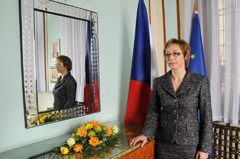
H.E. Mrs Hana Hubáčková, Ambassador of the Czech Republic to Serbia
The Czech Republic became an independent state in January 1993 after Czechoslovakia split into its two constituent parts. Before World War II, Czechoslovakia was one of the 10 most industrialized states in the world, and the only central European country to remain a democracy until 1938.
The Czech capital, Prague, is more than 1,000 years old and has a wealth of historic architecture of different styles. Because of this, the city has become a favoured location for many international film makers.
Manufacturing is still a major economic activity, especially the production of automobiles, machine tools, and engineering products. Iron and steel industries are important in Moravia in the east of the country. The chief crops are maize, sugar beet, potatoes, wheat, barley, and rye.
Hills and mountains cover about 95% of the country – ideal for skiing, mountain biking and hill walking. Wild boar and foxes are found in the abundant woodlands.
The Czech Republic produces world-famous beer, including Pilsner. Wine is produced in the southern regions of Moravia and in part of Bohemia.
A record 900 natural springs have also ensured that the country produces plenty of mineral water.
Traditional dishes include “knedlíky”, a type of dumpling made from potatoes or bread.
Czech Republic is a pluralist multi-partyparliamentaryrepresentative democracy, a member of the European Union,NATO, theOECD, theOSCE, theCouncil of Europeand the Visegrád Group.
We were very much honoured to speak to H.E. Mrs Hana Hubáčková, Ambassador of the Czech Republic to Serbia.
1.Your Excellency, could you tell us something about your impressions on Serbia and its capital?
I find Serbia gifted with talented and dynamic people who are devoted to their country, who are in a very respectable way dealing with their daily concerns and who work hard to make sure that Serbia is a good home place for all its citizens.
Belgrade is a buzzing capital, with a lot of events taking place every day. With its rich culture, history and a variety of attractions it is a pleasant and interesting town to visit and live in.
2.How long have you been at the position of Ambassador to Serbia and what was your diplomatic career like before this appointment?
I have been in Serbia as the Czech Ambassador for more than 4 years and it is a rewarding assignment. It is always good if you can see the results of your work.Before being posted here I had held various positions at the Ministry of Foreign Affairs in Prague. I had also been Ambassador to Hungary and worked as a diplomat in our Embassy in Belgium and in the Czech Delegation to NATO.
The Czech Republic is almost entirely surrounded by mountains (except the south, toward Austria and Slovakia). Mountains mark a natural border with Germany and Poland.
3.What was diplomatic cooperation between our two countries like in the past and what is it like now?
Our relations have always been close. Only look at all the events that brought us together in the course of the 20th century.
Even at difficult times our peoples showed a sincere interest in the fate of the other. My country is devoted to contribute to peace and stability of this part of Europe. Economic prosperity is an inseparable part of it. That´s why we endeavour to develop our relations in all its multifaceted variety.
In recent times, Serbia´s aspirations to join the EU opened new venues for our cooperation. We are pursuing those venues in close coordination with Serbian authorities, who believe that our experience can be valuable for what is ahead of Serbia in the years to come.
The Czech flag consists of red, blue and white. The colours stand for the following: Red (blood shed for freedom), Blue (sovereignty) and White (traditional Bohemian colour and also represents sky)
4.Economic relations between the Czech Republic and Serbia have been constantly developing in the last 10 years. Could you tell us something more about economic exchange and how could it be improved?
It is true that during the last 10 years the turnover of trade in goods between our countries has increased more than 5 times. Only last year we experienced an increase of 49% with the total amount reaching EUR 584 mil. Value of Czech export to Serbia was EUR 390 mil and Serbia exported to our country goods of total value of EUR 193 mil.
Serbia is 29th most important market for Czech exporters and for Serbian exporters Czech Republic is 20th. We believe that these figures are still far from the full potential of our economies. Our economic relations mostly take the form of pure trade, while we should aspire to establish deeper forms of cooperation, be those investments, joint ventures or cooperation in the fields of technology and science.
The country is renowned for its numerous spa towns, especially along the border with Saxony (Germany). The most famous ones are those of Karlovy Vary (Karslbad), Františkovy Láznĕ (Franzesbad) and Teplice (Teplitz). There are over 2.000 castles, keeps and castle ruins in the Czech Republic, one of the highest density in the world (after Belgium and France).
5.When speaking of investments, what is total amount of Czech investments in Serbia and in which fields?
According to our data, the total value of Czech investments in Serbia during last 5 year amounted EUR 17,5 mil. The biggest investment was carried out by a Czech company MITAS, owner of tyre factory in the town of Ruma. Other investments target mostly energy sector (heating, renewable sources of energy).
6.To your knowledge, what are future plans for investing in Serbia and how does economic crisis affect those plans?
At present, there are a number of investment projects in the pipeline related mainly to the energy sector. Special focus is on renewable sources (especially small hydro power plants and biomass) but also on traditional fossil fuels. It is clear that the economic slowdown in Europe has had an impact on those plans as well.
Like others, the Czech companies are perhaps more carefully considering their investment plans abroad and more carefully studying overall conditions into which they would come with their investments. Stable and transparent business environment plays a role in their decision making. When it comes to Serbia, we do register a serious interest in the Czech Republic and we keenly support it.
The Czech Republic is the second richest new EU member state, after Slovenia.
7.What about Serbian investments in the Czech Republic?
Regretfully we do not register any bigger Serbian investment. On the other side, I have noticed that some service-related businesses have been opened recently in Prague whose owners are of Serbian origin.
8.How do you see Serbia’s EU integrations in the future and will it become, in your opinion, more attractive to investors, not only from Czech Republic, but also from other countries, after joining the EU?
Integration into EU, for any country and by definition, is a long term endeavour consisting of a few clearly defined stages. Let me refer to our case. We applied in 1996 and completed the whole process by becoming a member in 2004.
Serbia is well on the way. It has experienced people, it has established the administrative and coordination structures and it does display the necessary political will to move forward. If Serbia continues to focus on what is needed to be done, I do not see any reason why it should not succeed to meet all the criteria for accession.
Joining the EU is of course a very strong signal for the possible foreign investors. Participation in the internal market brings a huge number of opportunities. I am sure that Serbia, with its industrial tradition and potential, with qualified labour force, will become a logical target for foreign investors. An increased number of them could be expected even before the actual accession to the EU.
9.What do you think about EU’s future?
I am rather an optimist. The EU has been the most important post World War II European project, which has brought stability and prosperity to many European nations, including mine. Of course, it has been recognized by many that the current difficulties of fiscal and economic nature of the EU are not minor. We, the whole EU, are at a critical junction. It is about the future way of Europe which is being worked on right now, these days. Future to which Serbia belongs, too.
The EU has so far always been able to find the remedy to various challenges it faced in its history. And we can see a lot of political dedication and will on all sides to find the right solutions also for the crises we have faced now.
10.What is our two countries’ cooperation like in the field of culture?
It would take a lot of time and space to sum up all cultural ties of my country and yours over the last few decades, from cinematography to modern art and design. The cooperation is fairly intense and our Embassy is trying to help it as much as we can, being instrumental to cultural exchange or presenting Czech culture here.
Many Serbian artists studied in our country, some of them using scholarships provided by my government. There are regular contacts between artists, galleries and theatres. Director Jiří Menzel, a well known personality here in Serbia, is a frequent guest at the National Theatre in Belgrade. Its Director Mr. Božidar Djurović is a keen promoter of Czech culture. Czech and Serbian books are translated and published in both countries. There are Serbian personalities awarded the Gratias Agit Prize, dedicated to those who did a great job in promoting Czech culture abroad. The College of Bohemistics at the Belgrade University has had year by year more and more applicants for studies. This is just a split of the volume of what is, perhaps sometimes invisibly, taking place in the Czech-Serbian cultural domain.
Pragueis the capital andlargest cityof theCzech Republic. It is the fourteenth-largest city in theEuropean Union.It is also the historical capital ofBohemia proper. Situated in the north-west of the country on theVltavariver, the city is home to about 1.3 million people. Prague has been a political, cultural, and economic centre of central Europe during its 1,100-year existence. Founded during theRomanesqueand flourishing by theGothicandRenaissanceeras, Prague was not only the capital of the Czech state, but also the seat of twoHoly Roman Emperorsand thus then also the capital of theHoly Roman Empire.It was an important city to theHabsburg Monarchyand itsAustro-Hungarian Empireand afterWorld War Ibecame the capital ofCzechoslovakia. The city played major roles in theProtestant Reformation, theThirty Years' War, and in 20th-century history, during both World Wars and the post-war Communist era.
11.When you have free time, how do you spend it in Belgrade? Do you have any favourite places you like to visit often?
When I have visitors coming, I have to admit I mostly go to well known attractions in Belgrade such as Kalemegdan, Terazije or Skadarska ulica. I also like your National Opera very much. When I have a bit more time over the weekends, I tend to leave the capital and see some of your beautiful countryside. I have been to many places, but even after four years, there is still a lot to see.
12.When you leave Serbia, what will be your favourite memory of staying in our country?
I will fondly remember a lot of people with whom I hope I will stay in touch even when I am elsewhere.
Beer in the Czech Republic(Czech:pivo) has a long and storied history. The first brewery is known to have existed in 1118. The city of Brnohad the right to brew beer from the 12th century, and the two cities most associated with Czech beer,PlzeňandČeské Budějovice (Pilsen and Budweis in German), had breweries in the 13th century. The Czech Republic has the highestbeer consumption per capitain the world. The most famousCzechbeer brands (and the most exported ones) arePilsner Urquell, which was the world's firstpilsnerandpale lagerbeer, andBudweiser Budvar(in some countries trademarked asBudějovický BudvarorCzechvar). Other well known brands include:Velkopopovický Kozel,Gambrinus,Radegast,Staropramen,Krušovice,Starobrno,Bernardand Svijany.


